
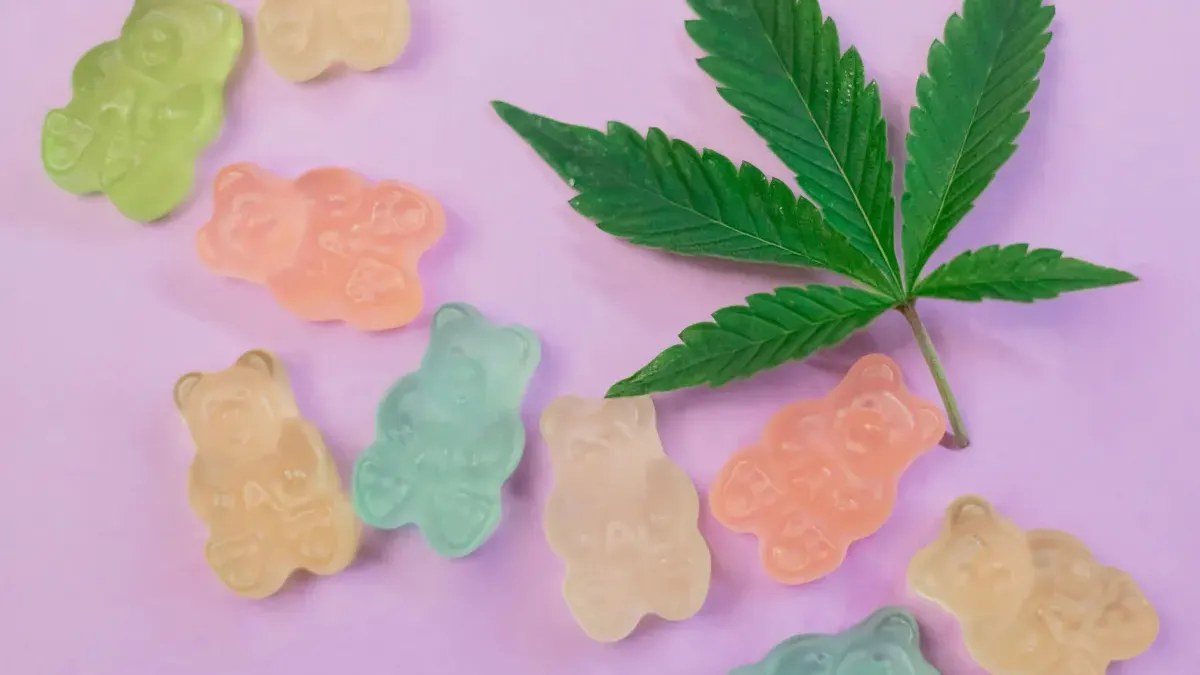
Cannabis gummies are a form of edible cannabis product. THC effects can begin more slowly than with inhalation, making them easy to misjudge. In regulated markets, THC products include sweets, chocolate and drinks.
They may resemble ordinary treats, but their effects and risks differ substantially from smoking or vaporization.
In Estonia, distinguish THC products, CBD and ordinary hemp seed foods. Products described online as ‘cannabis products’ do not all belong to one legal category.
What are cannabis gummies?
They are gummy sweets containing added cannabis-derived compounds, or cannabinoids.
Familiar examples include:
- THC, or tetrahydrocannabinol;
- CBD, or cannabidiol;
- CBG, or cannabigerol;
- CBN, or cannabinol.
Internationally, the term often refers to THC products. THC can produce intoxication, while CBD does not produce a comparable high. This distinction also matters legally in Estonia.
Why do edibles act differently?
Inhaled compounds enter through the lungs and can act relatively quickly. Edibles pass through digestion and metabolism first.
Effects can therefore:
- begin after a substantial delay;
- last longer;
- feel stronger or different from inhalation;
- vary considerably between people.
A common problem is taking more too soon because the initial portion seems inactive. When successive amounts begin acting later, effects can be much more intense than expected.
How are gummies generally manufactured?
Commercial production begins with a controlled confectionery mixture. Cannabinoids dissolve poorly in water, so manufacturers use suitable carriers and emulsification to distribute the compound as evenly as possible.
The sweets are then shaped, cooled and packaged. Laboratory checks are particularly important in regulated supply: the producer needs to know both total batch content and content per sweet.
Achieving uniform distribution at home is considerably harder. Knowing a batch’s total content does not mean every sweet contains an equal amount.
Homemade cannabinoid sweets therefore cannot be assumed equivalent to laboratory-controlled products.
Are THC gummies legal in Estonia?
THC is a controlled narcotic or psychotropic substance in Estonia. Handling is generally prohibited outside statutory exceptions such as authorised medical or scientific use.

Processing controlled cannabis into oil, extract or an edible cannot simply be treated as ordinary cooking. Making it for personal use rather than sale does not automatically authorise manufacture.
Recipes from the US, Canada or elsewhere cannot automatically be applied in Estonia, where legal conditions differ.
What about CBD gummies?
CBD involves a separate set of distinctions.
CBD itself is not scheduled as a narcotic or psychotropic substance in Estonia and does not produce THC-like intoxication.
That does not automatically authorise every CBD food. Flower- or leaf-derived extracts and cannabinoid foods generally fall under EU novel food rules.
Unauthorised CBD extracts and cannabinoid products cannot simply be marketed as ordinary foods. Distinguish these questions:
Is CBD itself a narcotic substance?
Generally, no.
Can CBD gummies be freely sold as food in Estonia?
Not automatically: separate novel food requirements apply.
Hemp seed foods are different
Confusion arises because ordinary legal foods include:
- hemp seeds;
- hemp seed oil;
- hemp protein;
- foods made from hemp seeds.
These differ from products containing cannabinoid extracts.
Hemp seeds naturally contain little or virtually no cannabinoids, and seed-based foods have a long European history of consumption.
The word ‘hemp’ on packaging therefore does not automatically mean CBD or THC.
Why does the amount matter particularly with gummies?
Their appearance is a major concern.
Looking and tasting like ordinary sweets makes unintended overconsumption easier.
Children are particularly vulnerable because they may not recognise a psychoactive ingredient. Keep cannabinoid products securely inaccessible to children and pets, in clearly distinguishable packaging.
Why can edible effects be unpredictable?
Relevant factors include:
- the amount of the particular compound;
- individual body size and metabolism;
- previous tolerance;
- whether it was taken with food;
- other substances used at the same time;
- the product’s actual composition.
With unregulated products, labels may not match contents.
This is particularly important with newer and semisynthetic cannabinoids, whose effects and risks can differ substantially from familiar THC or CBD.
Estonia changed cannabinoid controls in 2026
In August 2026, Estonia added a new group of semisynthetic cannabinoids to its controlled-substance schedules, covering several compounds and derivatives.
CBD was excluded from that group, but its food rules remain separate. Claims such as ‘legal THC’ or ‘THC alternative’ do not establish legality in Estonia.
Are gummies safer than smoking?
They avoid smoke inhalation, but are not risk-free. Their main concerns differ:
- delayed onset;
- prolonged effects;
- misjudging the amount;
- uneven distribution in homemade products;
- unknown composition in unregulated products;
- accidental consumption by children attracted by the appearance.
Risk depends on the compound, amount and whether supply is controlled and lawful.
What if someone has taken too much?
Excessive THC can cause anxiety, panic, confusion, a faster heart rate, impaired coordination, nausea and marked drowsiness.
Take particular care with children, older people and those with other health conditions.
For severe symptoms, impaired consciousness, breathing problems or another emergency, seek urgent medical help. In Estonia, call 112.
Summary
Gummies are one edible format, popular particularly in regulated cannabis markets.
In Estonia, THC, CBD and ordinary hemp seed foods must be clearly distinguished.
THC handling is prohibited outside statutory exceptions. CBD itself is not scheduled, but foods with CBD extracts and other cannabinoids face EU novel food requirements.
Foreign THC or CBD recipes cannot simply be transferred to Estonia’s legal context.
Before buying cannabinoid sweets or other edibles online, check the compound’s status and whether the particular product may be marketed as food in Estonia.
Related reading: Estonian cannabis law in 2026 and cannabis effects and health risks. Check applicable requirements before making or using cannabinoid products.