
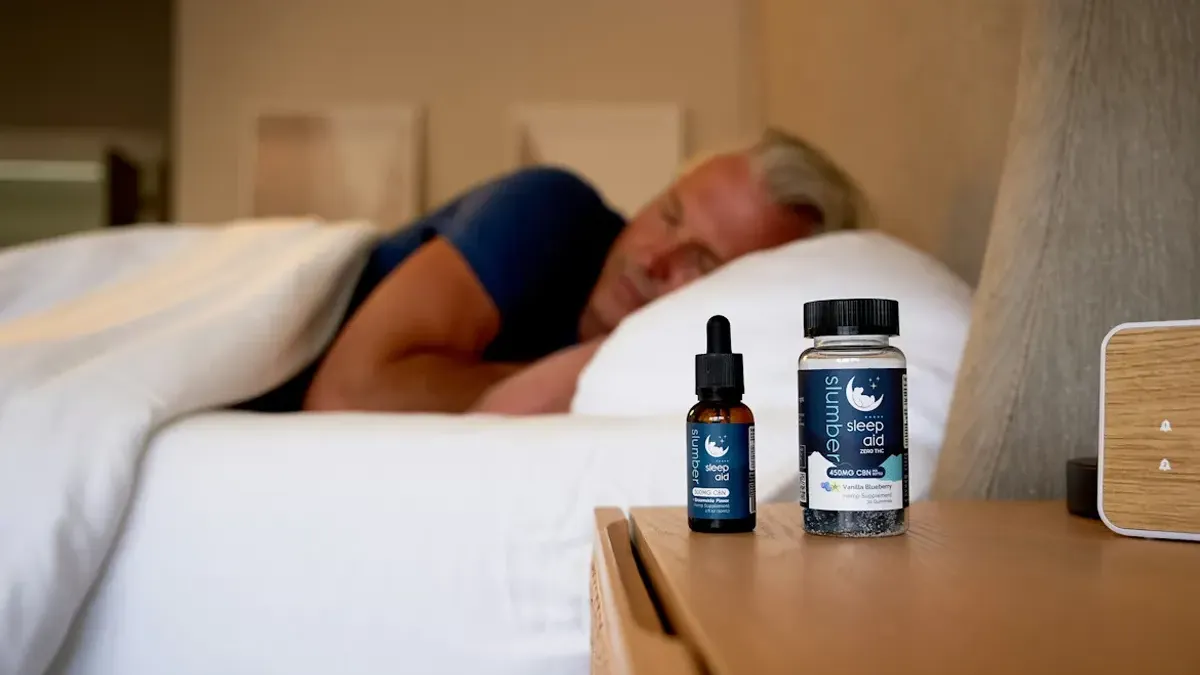
CBD, or cannabidiol, has attracted attention for its possible effects on sleep, stress and wellbeing. Many people seek better sleep, and cannabis compounds have become an active research area.
CBD has been studied, but the findings do not establish it as an insomnia treatment. Trials have observed changes in sleep quality and stages with cannabinoids, yet results are inconsistent and CBD differs from THC-containing preparations.
Could CBD improve sleep? What have researchers actually found, and why is it not yet a proven insomnia medicine? Here are the main studies and their conclusions.
What is CBD, and why study it for sleep?
CBD is a cannabis cannabinoid that does not usually produce THC’s characteristic high. It is nevertheless biologically active, affecting several nervous-system pathways, with possible medical uses under investigation.
Researchers are interested in sleep–wake regulation. Sleep problems have varied causes, including stress, anxiety, chronic pain, irregular schedules and health conditions. Studying CBD in some of these contexts raises questions about direct and indirect sleep effects.
CBD is not a conventional sleeping medicine, and its mechanisms are not fully understood. Our guide to cannabis and its active compounds provides broader background.
How does sleep work?
Sleep cycles through stages including light sleep, deep sleep and REM sleep, which is associated with more vivid dreaming.
Deep sleep contributes to restorative processes, while REM is involved in memory and emotional processing.
Good sleep involves more than time in bed: time to fall asleep, awakenings, continuity and next-day functioning all matter.
This distinction also matters in research. An increase in one stage does not automatically mean longer sleep or feeling better in the morning.
How might CBD influence sleep?
Possible mechanisms include the endocannabinoid system, which helps regulate stress responses and nervous-system activity among other processes.
Interactions with serotonin signalling and other pathways are also studied. Some researchers propose indirect effects through anxiety-related symptoms in certain circumstances.
Affecting a relevant biological system does not prove treatment efficacy. Clinical comparisons with placebo are needed.
Our article on CBD and anxiety explores that area in more detail.
What do clinical trials show?
Several interesting studies have produced differing results.
2024 trial: most sleep measures did not differ from placebo
An analysis in the Journal of Clinical Sleep Medicine of a 2024 pilot trial included 30 people with moderate or severe insomnia.
CBD was compared with placebo on insomnia severity, time to fall asleep, sleep efficiency and awakenings.
Most sleep measures showed no statistically significant difference. Some improvements in wellbeing and one objectively measured sleep-efficiency outcome were observed in the CBD group.
The small sample and short duration prevent firm conclusions.
2025 trial: a CBD and terpene combination changed sleep stages
A 2025 trial involved 125 people with insomnia and tested CBD combined with several terpenes, aromatic compounds also present in cannabis.
Compared with placebo, the combined proportion of deep and REM sleep increased by about 1.3 percentage points on average, with larger changes in some subgroups.
Total sleep time did not increase significantly. The result cannot be attributed to CBD alone because the preparation also contained terpenes.
It supports further investigation rather than establishing that ordinary CBD oil improves everyone’s sleep.
The 1,793-participant trial: why interpretation needs care
A 2023 trial randomly assigned 1,793 adults to six groups. The final analysis included 1,298 because some participants lacked required outcome responses. Preparations contained CBD, other cannabinoids or melatonin.
Several groups reported fewer sleep problems, but the trial compared active formulations without a placebo group.
It therefore cannot establish how much improvement resulted from CBD rather than other factors.
The study helps compare formulations, but does not prove an independent CBD treatment effect for insomnia.
What do larger reviews conclude?
A 2025 Sleep Medicine Reviews meta-analysis combined six randomised trials involving 1,077 participants.
Some cannabinoid preparations improved subjective sleep quality overall. CBD-only treatments, however, did not show statistically significant improvement over placebo in that analysis.
A positive conclusion about cannabinoids cannot automatically be applied to CBD.
The 2026 Cochrane review
An October 2026 Cochrane review assessed nine trials involving 537 adults with insomnia, with an evidence search extending to April 2025.
The trials used different medical cannabis preparations containing CBD, THC or combinations.
The cautious conclusion was that medical cannabis may not provide clinically meaningful improvements in sleep quality, total sleep time or daytime functioning.
Adverse effects may also be more common. Evidence certainty was low: studies were often short, small and used substantially different formulations.
This does not disprove every possible benefit. It shows that reliable evidence is insufficient to recommend CBD as a general insomnia treatment.
Could CBD still help some people sleep?
Possibly. Individual experiences differ, and some studies have reported positive results for particular outcomes or participants.
Other conditions, such as stress or anxiety, may contribute to a person’s sleep difficulties, and their relationships with CBD are also under investigation.
Distinguish personal experience, an observed association and an established treatment effect.
Reporting better sleep while using CBD is meaningful to that person, but does not alone establish causation or predict the same result for others.
Other cannabinoids are also associated with sleep and relaxation. CBN is often marketed for sleep despite limited clinical evidence.
Our overview of CBD, CBG and CBN explains what is known about their differences.
Does more CBD mean better sleep?
There is no reliable basis for that conclusion. Trials use widely varying amounts, which are not automatically appropriate for self-treatment.
Nor is there an established simple rule that small amounts stimulate and large amounts reliably improve sleep. Effects depend on the formulation, individual and other factors. Larger amounts can increase adverse effects and interactions.
Current research does not support one general CBD dosing schedule for sleep.
Adverse effects and interactions
Lack of a THC-like high does not mean complete safety. Reported effects include drowsiness, fatigue, diarrhoea and appetite changes.
CBD can affect liver enzymes and the metabolism of some medicines, including certain epilepsy medicines, anticoagulants and sedatives. Use during pregnancy and breastfeeding should be avoided.
EFSA’s 2026 assessment set a provisional safety level for specified high-purity preparations of approximately 2 mg daily for a 70-kilogram adult. This precautionary assessment is not a recommended treatment dose or evidence of sleep benefit.
EFSA also said available data could not adequately establish safety for people under 25, pregnant or breastfeeding people, or those taking medicines.
Are CBD products permitted in Estonia?
CBD itself is not listed as a narcotic or psychotropic substance in Estonia. A substance’s status and permission to market a particular product are different questions.
EU novel food rules apply to CBD foods and supplements. CBD extracts cannot be marketed as foods or supplements in Estonia without the required authorisation.
The existence of a prescription CBD medicine does not give ordinary consumer products the same evidence or marketing authorisation. Health claims and legality need separate assessment.
Which insomnia treatments have stronger evidence?
Chronic insomnia has better-established approaches, including cognitive behavioural therapy for insomnia, or CBT-I. It addresses thoughts and behaviours maintaining sleep problems and is a recommended first-line option.
A regular schedule, daytime light, a suitable sleep environment and attention to caffeine and alcohol can also help.
Discuss persistent or functionally disruptive problems with a clinician. Sleep apnoea, chronic pain or other conditions may need separate assessment. CBD research does not replace identifying those causes.
Frequently asked questions
Does CBD help people fall asleep faster?
Some findings are positive, but a reliable effect on time to fall asleep is not established. Results vary by preparation and study.
Does CBD improve deep sleep?
One 2025 CBD–terpene trial increased combined deep and REM sleep. It does not show that CBD alone improves deep sleep for everyone.
Do CBD and THC affect sleep in the same way?
No. CBD and THC differ in mechanisms and intoxication. Findings for THC or combinations cannot automatically be assigned to CBD.
Is CBD a natural alternative to sleeping medicines?
CBD is plant-derived, but natural origin establishes neither efficacy nor safety. Evidence is insufficient to replace conventional insomnia treatment with CBD.
Can CBD interact with sleeping medicines?
Yes. CBD can alter medicine metabolism and increase unwanted effects with sedating treatments. Discuss potential interactions with a healthcare professional.
Summary: a worthwhile research question
Research into CBD and sleep has expanded considerably in recent years.
Some studies show changes in quality or particular stages; others find no clear advantage over placebo.
Larger reviews suggest substantial formulation differences and cautious conclusions about CBD alone.
These findings support better-designed trials to answer remaining questions.
The most accurate current position is that possible potential remains, while efficacy and safety as an insomnia treatment require confirmation. This article is informational and does not replace medical advice.