
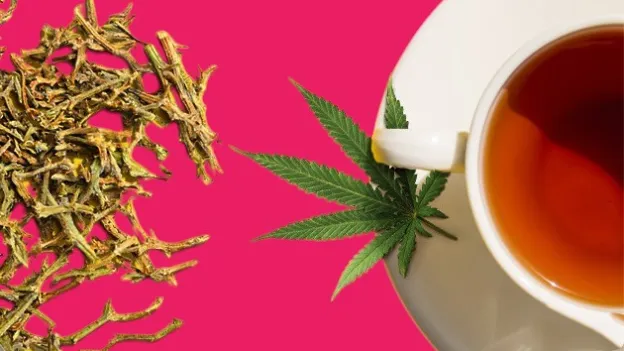
Cannabis flowers receive most attention, but online recipes also propose using stems and small branches for tea. They often promise relaxation or psychoactive effects and present stems as a way to use leftovers.
A stem infusion cannot be equated with flower-based products. Stems can contain cannabinoids, generally much less than flowers. THC, CBD and other cannabinoids also dissolve poorly in water, so cannabis tea differs from an ordinary herbal infusion.
In Estonia, the source plant matters legally. Possessing or processing narcotic cannabis does not become lawful merely because stems replace flowers.
Do stems and branches contain THC?
Yes, but usually little.
Cannabinoids are concentrated in glandular trichomes, particularly on and around female flowers.
Thick stems and larger branches have far fewer of these structures. Composition therefore differs by plant part. Broadly:
- flowers contain the most cannabinoids;
- small leaves near flowers can also contain appreciable amounts;
- larger leaves generally contain less;
- thick stems and branches usually contain the least.
This does not make every stem THC-free. Composition depends on the plant, variety and attached material.
Can stem tea get someone high?
Strong psychoactive effects should not be assumed from an ordinary water-based stem infusion.
There are two main reasons.
Stems usually contain little THC, and cannabinoids dissolve poorly in water.
Laboratory studies find only a small proportion of plant THC transferring into plain-water infusions. Some cannabinoids can be present, but the quantity may be low and difficult to predict.
Why is THC poorly water-soluble?
THC and many cannabinoids are lipophilic: they dissolve more readily in fats and certain organic solvents than in plain water. Unlike many water-soluble compounds in peppermint or chamomile, their transfer into hot water is limited.
Preparation and ingredients can greatly alter cannabinoid content. Appearance or a recipe cannot reliably establish a homemade drink’s THC amount.
Why do some recipes add milk, cream or fat?
This reflects cannabinoids’ fat solubility. Research has found greater THC and CBD transfer when fatty ingredients are present. It also means potency becomes harder to predict.
A 2024 laboratory study confirmed that a drink’s composition can markedly change THC transfer. Different recipes cannot be assumed to produce the same strength.
What is THCA and why does it matter?
Fresh or dried cannabis does not contain all potential THC as active delta-9-THC. Much may be THCA, tetrahydrocannabinolic acid. The compounds differ, and heating can convert THCA to THC through decarboxylation.
Online guides often aim to maximise this conversion before food or drink preparation. In Estonia, processing narcotic cannabis to obtain a stronger preparation also raises legal issues; cooking does not remove controlled-substance restrictions.
Has cannabis tea been studied?
Yes. Laboratory analyses have found transfer of THC, THCA, CBD and other cannabinoids into infusions, with substantial variability.
Factors include:
- plant composition;
- initial THC and CBD content;
- plant part;
- liquid composition;
- preparation conditions.
A 2023 study by Triesch and colleagues analysed 23 commercial hemp teas. Under its conditions, an average 0.5% of the delta-9-THC in dry material transferred to water. This does not mean the finished drink contained 0.5% THC, and the study was not specifically about stems alone.
No universal THC concentration can therefore be assigned to cannabis tea.
Is stem tea healthy?
That claim is not established. Stems contain plant fibres and other compounds, but this does not demonstrate disease treatment or special health benefits from an infusion.
Online claims sometimes include:
- anti-inflammatory effects;
- better sleep;
- stress relief;
- pain relief;
- improved digestion.
Research on individual cannabinoids does not establish clinical effects from an infusion of unknown composition. Calling it a healthy drink without knowing its active ingredients can be misleading.
Is cannabis tea the same as CBD tea?
Not necessarily. Products labelled CBD tea vary considerably. Our CBD, CBG and CBN guide explains cannabinoid differences. Some teas may use parts of compliant industrial hemp.
Others mix hemp with herbs or use CBD mainly as a marketing term. The label does not guarantee a meaningful or accurately measured CBD amount. CBD is also poorly water-soluble.
Hemp-seed tea and stem tea are different
Seeds differ from flowers, leaves and stems and are not themselves a significant THC or CBD source. A seed drink therefore differs from an infusion containing cannabinoids. Similarly, ordinary hemp-seed oil is different from CBD oil or a THC-rich extract.
The word cannabis alone tells us little about effects.
Is preparing stem tea legal in Estonia?
The source plant is crucial. Estonian rules distinguish compliant industrial hemp from narcotic cannabis.
Certain EU Common Catalogue varieties with THC not exceeding 0.3% receive different treatment under specified conditions. Narcotic cannabis and its processed products remain subject to controlled-substance rules.
A stem does not automatically become lawful because it is not a flower. Possession and processing may still be unlawful when the material comes from narcotic cannabis. See our Estonian cannabis legality guide.
Does less than 0.3% THC make every tea legal?
No. This threshold is frequently oversimplified online.
It is not a universal permission for every low-THC product. Estonia’s exception relates to compliant industrial-hemp varieties in the EU catalogue.
Finished products can also face:
- food-safety requirements;
- novel-food rules;
- medicine regulation;
- labelling requirements;
- other product-specific rules.
The particular plant and product must be assessed.
Is making narcotic cannabis into tea simply consumption?
Do not assume a hot drink changes a controlled substance’s status.
Handling narcotic and psychotropic substances is generally prohibited in Estonia outside legal exceptions.
Narcotic cannabis does not become lawful simply by being added to a drink. Foreign recipes cannot automatically be transferred to Estonia’s legal setting.
What about medical cannabis tea?
Some European countries use standardised medical cannabis as an infusion. That differs from a homemade drink using material of unknown origin.
Medical products provide information about:
- the variety;
- cannabinoid content;
- medicine quality;
- prescribed use;
- a controlled production chain.
Standardised materials allow researchers to measure transfer into an infusion. Unknown homemade material lacks that level of control.
Are there other uses for stems?
Industrial-hemp stems have established uses, including:
- textiles;
- rope;
- paper;
- building materials;
- insulation;
- animal bedding;
- composites.
Historically, fibre and seeds have been central uses of hemp. Stems need not be viewed only as cannabinoid sources.
Is smoking stems sensible?
There is no reason to recommend it. They contain fewer cannabinoids than flowers while still producing smoke and combustion products.
Low active-compound content does not make burning the material healthy. Irritation and harmful combustion exposure remain.
FAQ
Do stems contain THC?
Stems can contain THC, usually much less than flowers. The quantity depends on the plant, variety and attached material.
Can stem tea get someone high?
Strong effects should not be expected from plain-water stem tea: stems generally contain little THC, which dissolves poorly in water.
Actual content nevertheless requires laboratory measurement.
Does THC need activating for tea?
Cannabis contains THC and its acidic precursor THCA; heat can convert one into the other. This alone does not predict finished-drink potency.
Does CBD dissolve well in tea?
CBD is also lipophilic and poorly water-soluble. A plain infusion does not efficiently extract all CBD present.
Is cannabis tea legal in Estonia?
Legality cannot be decided from the name cannabis tea. Origin, THC content, product category and processing matter.
Possession and processing of narcotic cannabis are restricted in Estonia.
Is industrial hemp permitted in Estonia?
Compliant EU-listed industrial-hemp varieties with THC not exceeding 0.3% may be grown and handled agriculturally under specified conditions. This does not exempt every finished product from other requirements.
Conclusion
Stem tea is based on the fact that stems can contain small amounts of cannabinoids, usually far less than flowers.
THC and CBD dissolve poorly in water, but can transfer into drinks. The quantity depends on plant material and preparation, making visual estimates of homemade potency unreliable.
Stem tea is not an established health treatment. In Estonia, using stems or making a hot drink does not remove restrictions on narcotic cannabis.
Online recipes therefore require caution about effects, health claims and Estonian law.