
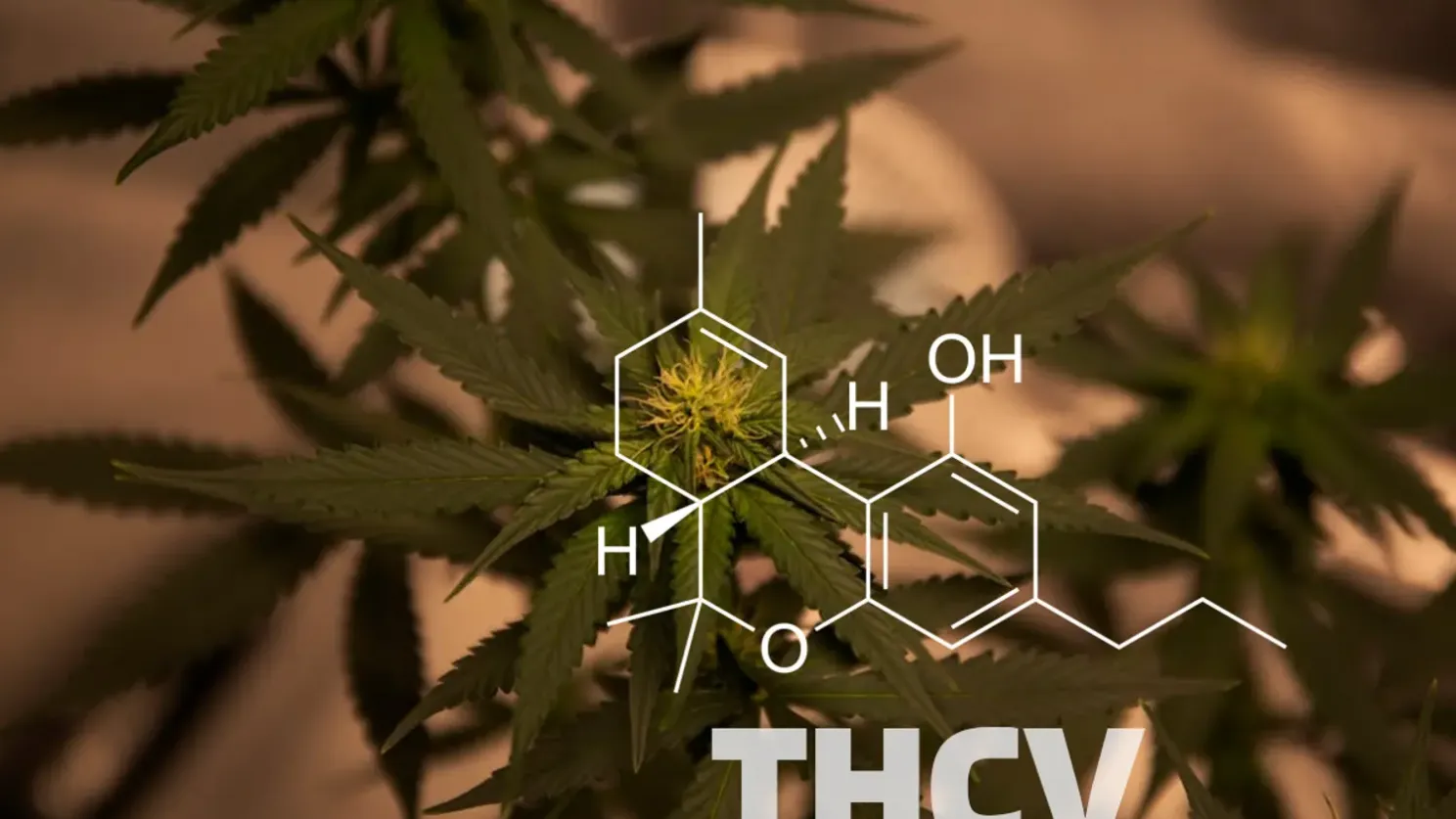
THCV, or tetrahydrocannabivarin, is one of the many cannabinoids naturally present in cannabis. Its name resembles THC, but the effects are not identical. It has recently attracted attention through nicknames such as ‘diet weed’ and ‘weederall’, alongside claims about appetite suppression, weight loss and increased energy.
Marketing currently runs ahead of scientific evidence. Human research is limited, and THCV is not an established weight-loss treatment. Our review of a small THCV study explains some of the limitations.
Its legal position in Estonia has also changed: since 14 August 2026, THCV falls within a substance group covered by Schedule VI of the narcotic and psychotropic substances list. Does THCV get you high? THCV and THC are chemically similar but differ in their effects.
In small human studies, pure THCV has not produced the clear intoxication associated with THC. In one study using 10 mg daily for five days, participants’ subjective experience was indistinguishable from placebo.
This does not establish that THCV has no psychoactive effects. Its effects depend on the amount, the particular form and the individual. Far less information is available than for THC or CBD.
One small study suggested THCV weakened some THC effects. Nine of ten participants rated THC’s effects as weaker after THCV than after placebo. Other effects were enhanced, however, so THCV should not be treated as an antidote to THC.
THCV is therefore distinct from THC and has not shown the same strong intoxicating effects at the amounts investigated so far. For a side-by-side explanation, read our THC, THCA and THCV comparison. Why is THCV called ‘diet weed’? The nickname mainly comes from its effects on CB1 receptors.
These receptors are involved in THC’s effects, appetite and the brain’s reward system. Under certain conditions, THCV can block or modify CB1 activity, prompting the theory that it could reduce the appetite increase commonly called the munchies.
Laboratory and animal work has produced interesting findings on metabolism, glucose tolerance and insulin sensitivity. Human findings are much less clear.
In a study of 20 healthy volunteers, participants received 10 mg THCV while researchers measured brain responses to chocolate and unpleasant food stimuli. Activity in some brain areas changed, but participants’ ratings of food pleasantness or wanting did not differ significantly.
There is therefore no good evidence that THCV simply switches appetite off. Does THCV help with weight loss? Evidence is currently insufficient to describe it as an effective weight-loss treatment. This is a clear example of online marketing outpacing research.
Researchers have studied metabolic effects in people with type 2 diabetes. A 2016 randomised trial enrolled 62 participants; some blood-glucose and pancreatic-function measures improved in the THCV group. It did not demonstrate significant weight loss with THCV.
Claims such as ‘fat burner’, ‘natural Ozempic’ or ‘weight-loss cannabinoid’ deserve scepticism. THCV may be an interesting metabolic research subject, but that does not establish a cannabis-based weight-loss treatment.
What else is THCV being studied for? Body weight is not the only research interest.
Research has examined glucose regulation, metabolic disorders, inflammatory processes and brain function. Much of the evidence still comes from animals, cells or very small human studies.
Online claims may suggest benefits for diabetes, Parkinson’s disease, inflammation, pain or psychiatric conditions. Current evidence does not establish THCV as a treatment or preventive measure for these conditions.
What amounts have human studies investigated? Studies have used different amounts. Several early human studies used 10 mg pure THCV; a type 2 diabetes trial used 5 mg twice daily for 13 weeks.
These figures do not define a standard dose. They describe what researchers examined under controlled conditions, not an amount established as safe or recommended for general use.
This distinction matters particularly in Estonia, where THCV is no longer freely permitted. Is THCV legal in Estonia? Since 14 August 2026, it is covered by a new Schedule VI group described as ‘semi-synthetic cannabinoids (cannabinol derivatives)’.
The State Agency of Medicines names THCV among its examples, including delta-9-THCV, delta-8-THCV and THCVO.
This can seem confusing because THCV occurs naturally in cannabis and is described as a phytocannabinoid in research. Nevertheless, Estonia’s current classification explicitly names it as an example of the Schedule VI group.
Handling narcotic and psychotropic substances is generally prohibited in Estonia apart from legally specified medical, scientific and other exceptions. Labels such as ‘legal’, ‘hemp-derived’ or ‘EU legal’ on a foreign shop do not establish that a THCV product is permitted in Estonia.
Conclusion THCV is an interesting cannabinoid with effects differing somewhat from THC, but the hype exceeds robust clinical evidence. Be particularly cautious about the ‘diet weed’ image: although THCV can affect systems involved in metabolism and appetite, current human research does not establish effective weight loss.
Human studies remain scarce, and many claimed benefits come from animal or laboratory work. The most important change since this article’s original publication is legal: since 14 August 2026, THCV falls within a substance group covered by Estonia’s Schedule VI. This article was updated on 15 September 2026.