

Cleaning a bong or pipe is often postponed until the glass is brown with residue, the water looks questionable or drawing through the pipe becomes difficult. It is worth cleaning much earlier.
There is no single scientifically established interval in days or uses. A practical rule is to change bong water after use and avoid letting visible residue accumulate.
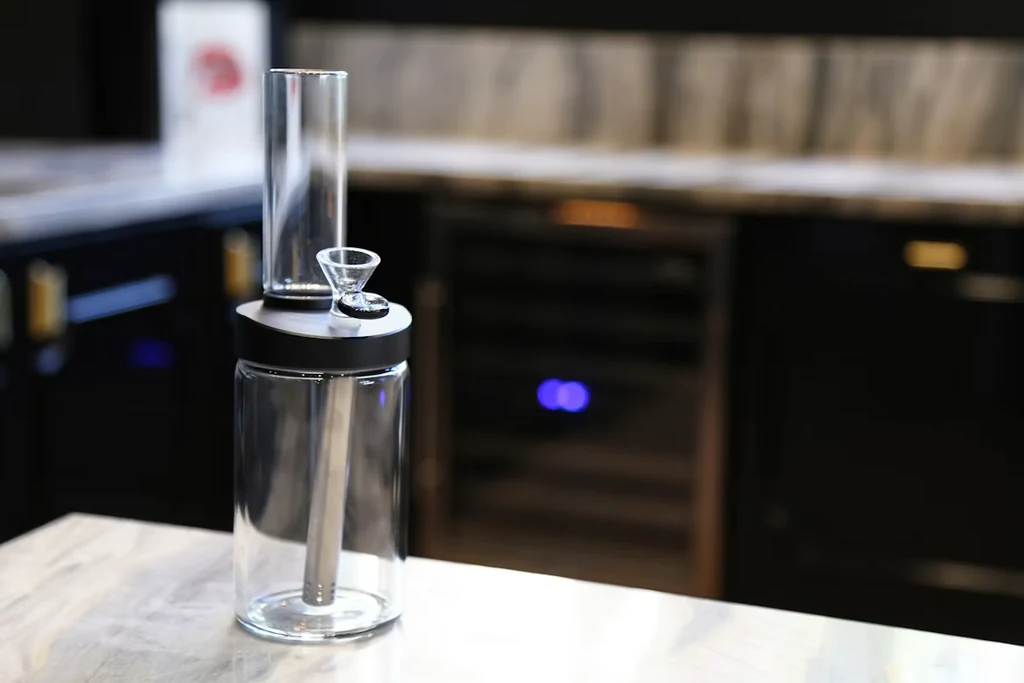
A dirty bong is more than a cosmetic issue
Burning cannabis produces smoke containing particles, tar-like compounds and other combustion products. Some collect as sticky residue on internal surfaces.
The layer thickens over time, affecting taste and smell and potentially restricting airflow.
Bongs also contain water. Warm stagnant water and organic material provide conditions in which microorganisms can multiply.
Microbiological studies of waterpipes have found bacteria in water, mouthpieces and hoses. Many concern hookahs rather than cannabis bongs, so findings cannot be transferred directly. The practical point remains: do not leave dirty stagnant water in a bong until the next use.
Change bong water after each session
The simplest habit is to empty the water after use.
Avoid leaving it for days or weeks and reusing it at the next session.
Fresh water helps prevent unpleasant smells and tastes and removes dirt that has collected in the old water.
If a bong is used several times during an evening, changing water after every draw is unnecessary. The end of a session is a reasonable point.
Once emptied, the bong can be briefly rinsed with warm water. This takes less than a minute and helps slow the build-up of stubborn residue.
How often is a thorough clean needed?

It depends on frequency of use.
With daily use, a thorough clean may be needed after a couple of days or at least weekly. Less frequent use may allow a longer interval.
Visible signs matter more than the calendar.
A brown coating, an unpleasant smell even after changing water, rapidly darkening water or reduced airflow all indicate that cleaning is due.
The easiest approach is to avoid letting the bong become very dirty. A thin, fresh layer is much easier to remove than weeks or months of sticky deposits.
The same principle applies to pipes
A dry pipe has no standing water, but residue can still accumulate quickly.
It collects particularly beneath the bowl and in narrow smoke passages, eventually affecting taste and airflow.
A pipe need not necessarily be dismantled and scrubbed after every use. Remove loose ash and plant debris, and clean more thoroughly when a substantial coating starts forming.
If noticeably more effort is needed to draw through it, cleaning has probably been delayed too long.
What can you use to clean a bong or pipe?
For glass bongs and pipes, isopropyl alcohol is often combined with coarse salt. Alcohol helps dissolve resin, while salt provides mechanical cleaning during gentle agitation. Use flammable solvents only on cool, compatible parts, away from heat, flames and other ignition sources.
Brushes of different sizes help with narrow tubes, chillums and hard-to-reach areas.
Purpose-made cleaning products and brushes can also help, particularly with percolators and other areas that ordinary brushes cannot reach easily.
Choose cleaning tools and products that are compatible with the material and the manufacturer’s care instructions.
After using a cleaner, rinse every part thoroughly with clean water and allow it to dry completely before use.
Different materials need different treatment
Glass generally tolerates many standard bong-cleaning methods, but acrylic, silicone and other materials require more caution.
Strong solvents can damage some plastics, cloud them or cause surface cracks. If the material is unknown or instructions are unavailable, use a cleaner suitable for that material, or warm water and dishwashing liquid where compatible.
Avoid sudden temperature changes even with glass. Pouring boiling water into a very cold bong, or the reverse, can cause thermal shock and potentially break it.
Do not mix cleaning chemicals indiscriminately
There is no reason to mix household chemicals for bong cleaning.
In particular, do not mix bleach, ammonia or different strong cleaners. Some combinations produce toxic gases.
Such chemicals are generally unnecessary here. A suitable cleaner, water and mechanical cleaning are usually sufficient.
A clean bong does not make smoking safe
An important distinction is needed.
Cleaning maintains the equipment, but does not make cannabis smoke harmless.
Smoke still contains combustion products after passing through water. The US Centers for Disease Control and Prevention notes that cannabis smoke can damage lung tissue whether inhaled through a joint, pipe or bong. It also contains many of the same irritants and toxic compounds as tobacco smoke.
Water may cool smoke and collect some particles, but a bong is not a filter that makes combustion smoke safe.
The simplest rule: clean regularly

No complicated schedule is necessary. For a detailed sequence, see our eight-step bong cleaning guide.
Empty water after use, rinse regularly and clean thoroughly when visible deposits appear. For pipes, watch residue build-up and airflow.
The more regularly you maintain the equipment, the less time each cleaning takes.
If the water is already brown, the glass sticky and the old water smells before you pick the bong up, cleaning is overdue.